Pulsars are some of the universe’s most dependable “clocks” — and some of its best pranksters. We’ve known about them for nearly 60 years, and on paper they look wonderfully simple: a tiny, ultra-dense star spinning and flashing like a lighthouse. Yet the moment you spend time with real pulsar data, you realize how much we still don’t understand. Why do some suddenly go quiet and then return? Why do others flicker, drift, or change their rhythm? What, deep down, is the engine that keeps them shining so reliably — until it doesn’t? I spent my entire PhD trying to understand why some pulsars suddenly stop “shining.” That uncertainty feeds into a bigger, more tantalizing mystery: the missing pulsars at the very center of the Milky Way. Astronomers expect that region to be crowded with them, especially near the galaxy’s central supermassive black hole, Sagittarius A*.
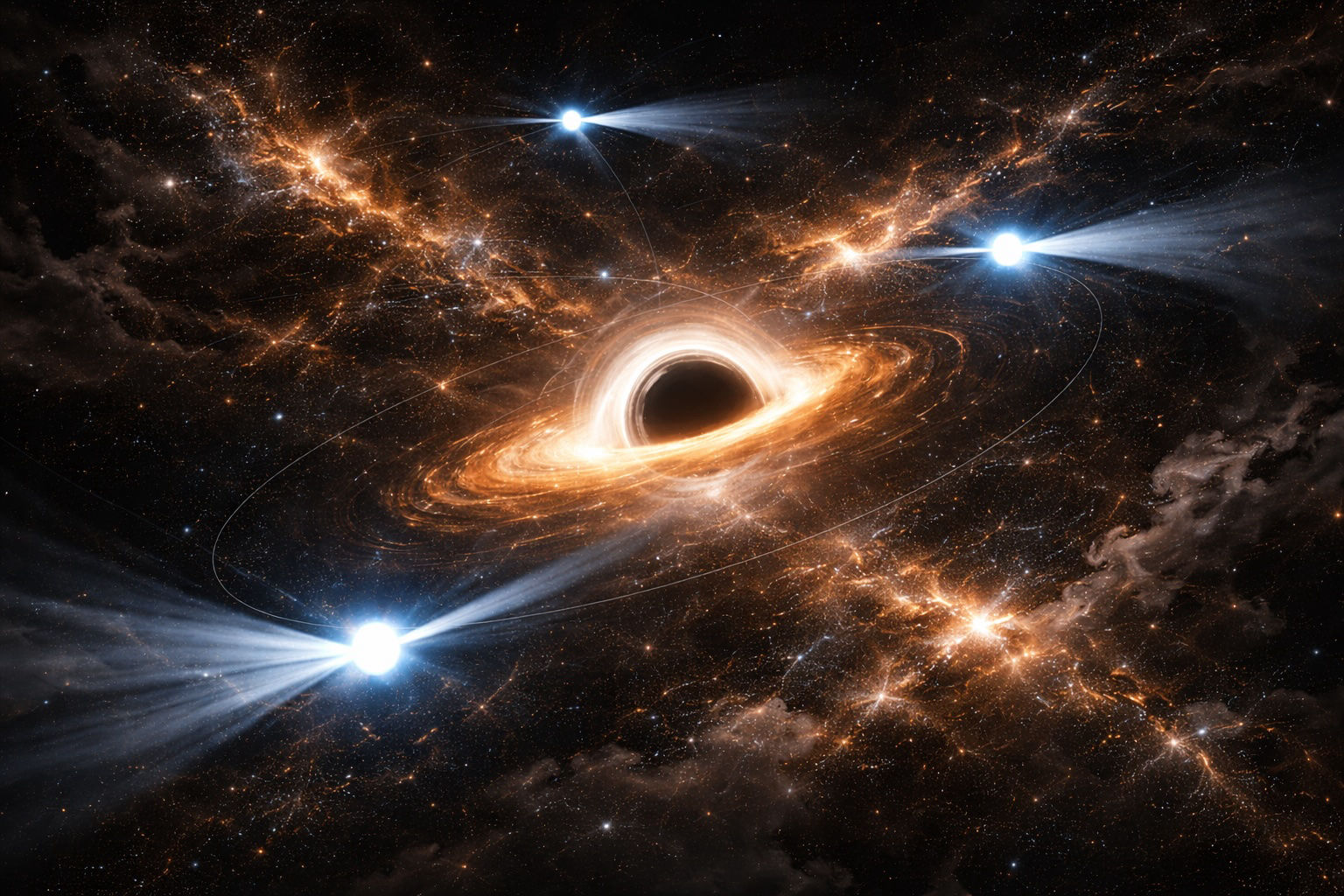
Finding pulsars near the center of the Milky Way matters because they would act like the best possible “clocks” placed next to the most extreme object in our neighborhood: the galaxy’s central black hole. Pulsars tick with astonishing regularity, so if we can spot one circling close to that black hole, we can track tiny changes in its timing and orbit that reveal how strong gravity behaves there. It would let us measure the black hole’s basic properties (like how heavy it is and how fast it’s spinning) and check whether gravity works exactly the way Einstein’s theory predicts under the most intense conditions we can access. Just as importantly, finding these pulsars would solve a long-standing mystery: we expect the crowded Galactic Center to be full of them, yet they’ve been frustratingly hard to detect — so even one clear detection would change our understanding of what’s happening in the Milky Way’s core.
“…a pulsar in orbit around the supermassive black hole in the Galactic center would provide an ideal probe to measure the mass, the spin, and the quadrupole moment of Sgr A*…”
Liu et al. 2012, ApJ, 747, 1
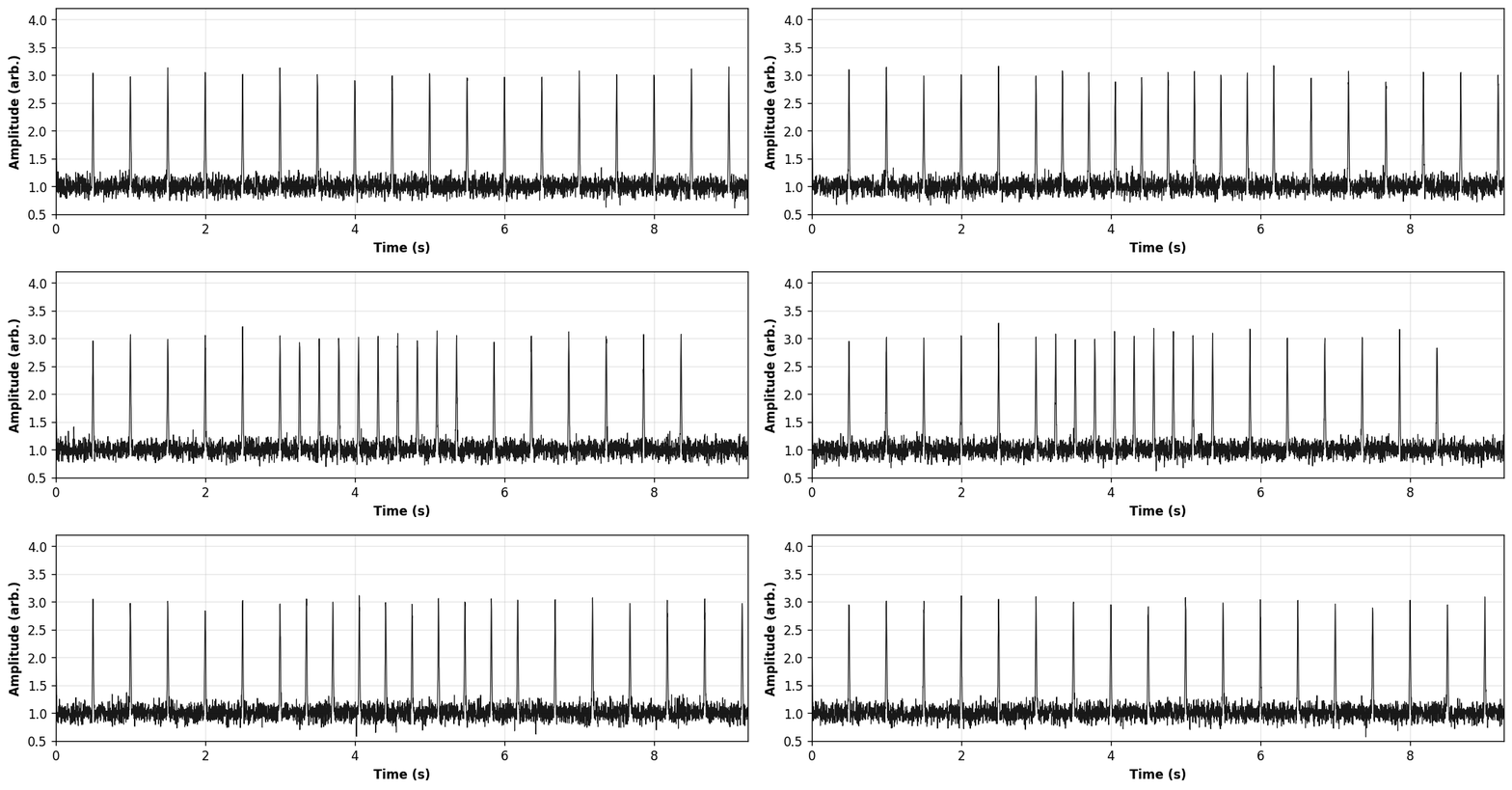
Having a millisecond pulsar orbiting a supermassive black hole is like placing an ultra-precise clock in the strongest gravitational potential and studying how spacetime behaves under extreme conditions by tracking subtle changes in its pulse period.
But, it’s hard to find pulsar in this environment because the Galactic Center is basically the worst possible place to try to hear a faint, steady “tick” — even with the best radio telescopes.
Put simply: even if pulsars are there, nature gives them plenty of ways to hide — and it gives our data plenty of ways to fake them.
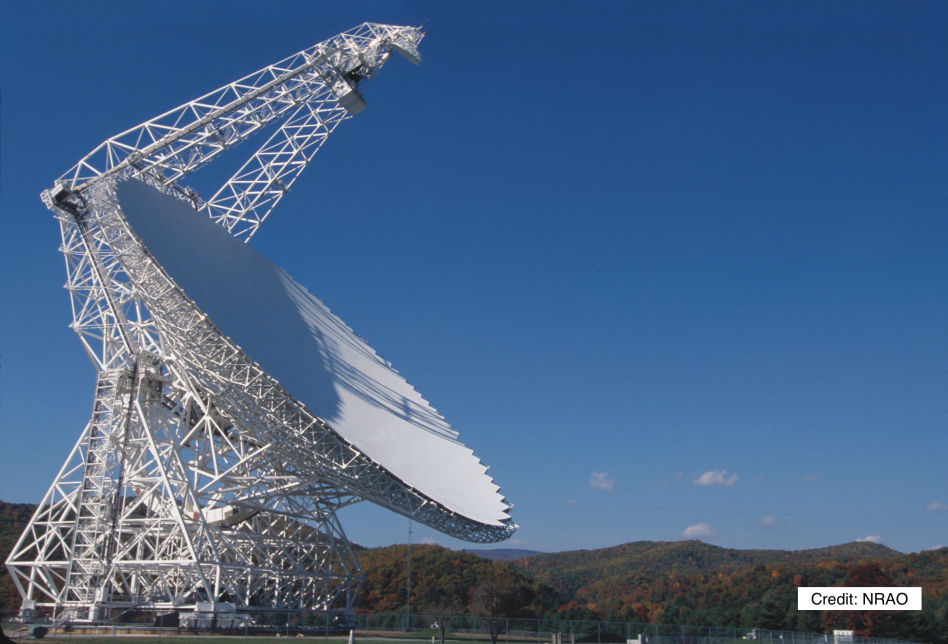
We used the Green Bank Telescope and observed at higher radio frequencies because the Galactic Center is especially good at smearing and blurring pulsar signals. At lower frequencies, the radio waves get distorted much more as they pass through turbulent material between us and the Milky Way’s center, which can wash a sharp “tick-tick-tick” into a soft, hard-to-detect blur. Higher frequencies cut down that distortion, giving pulses a better chance of staying sharp enough to recognize. The trade-off is that pulsars are often dimmer at higher frequencies, so we compensated by listening longer and going deeper with long observations.
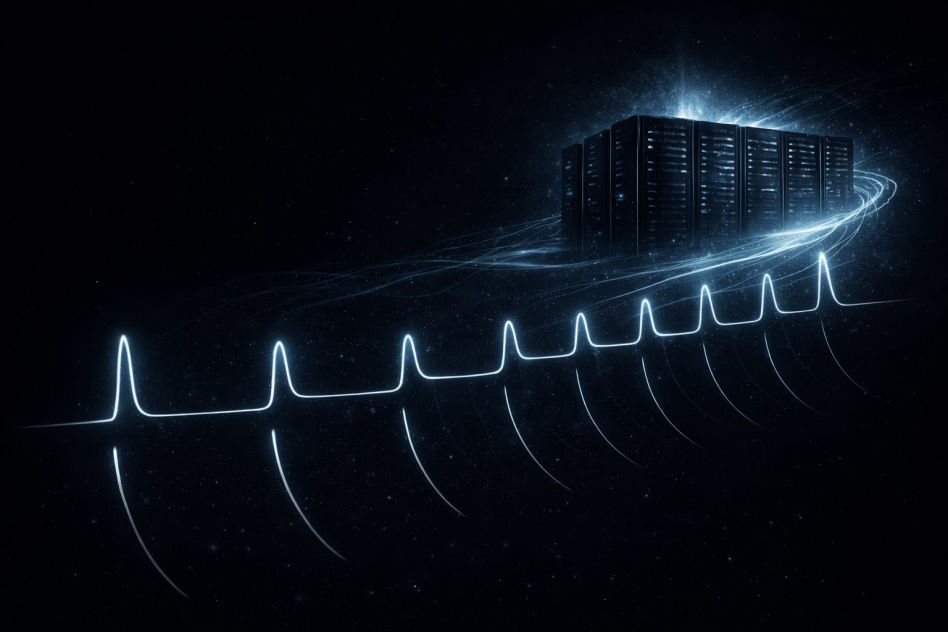
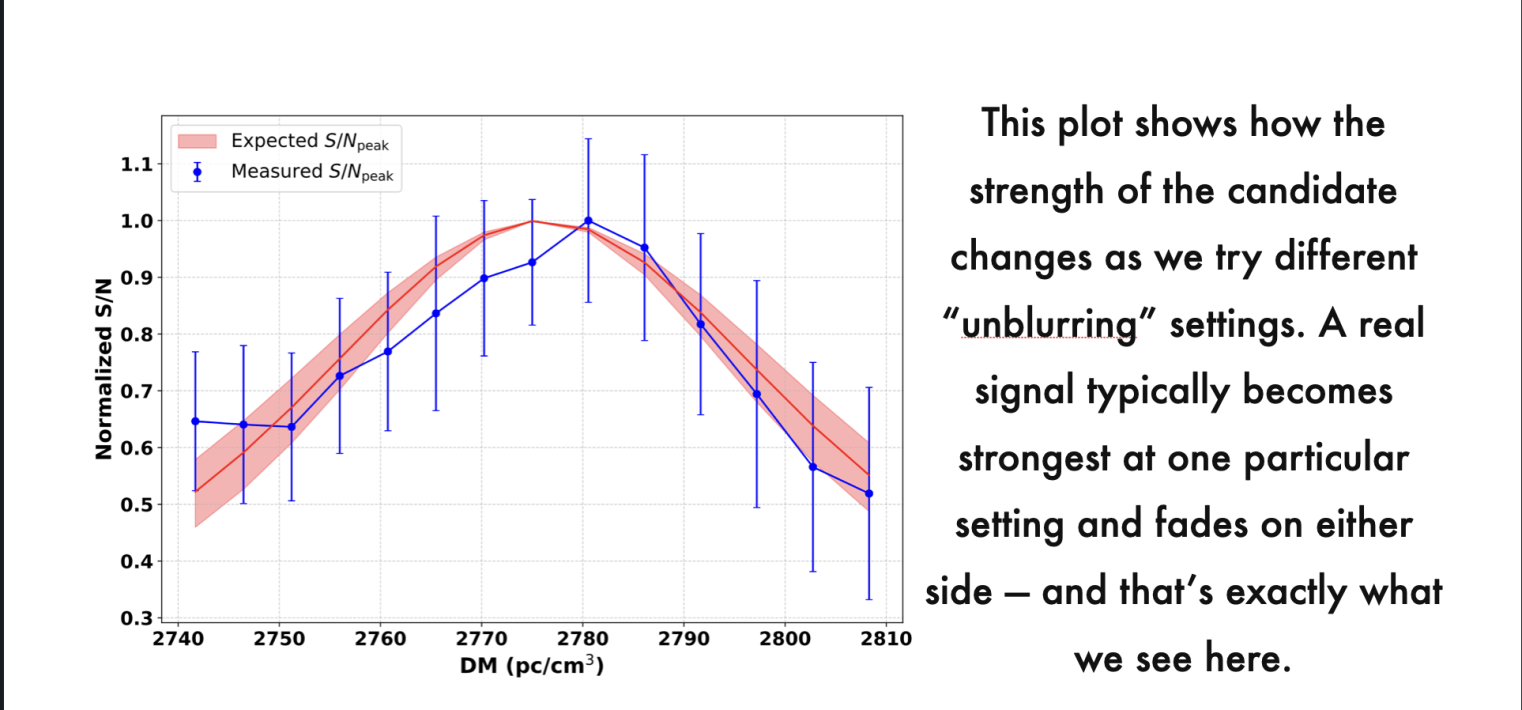
For each observation, we tested a wide range of “unblurring” settings that correct how the signal is delayed and smeared on its way to Earth. Then we ran searches designed to find extremely fast repeating pulses — even if the source is moving in an orbit that slightly scrambles the rhythm. This was a massive undertaking: it meant repeating the search many times across thousands of unblurring trials, which is why we needed supercomputing resources at the Columbia University to make it feasible.
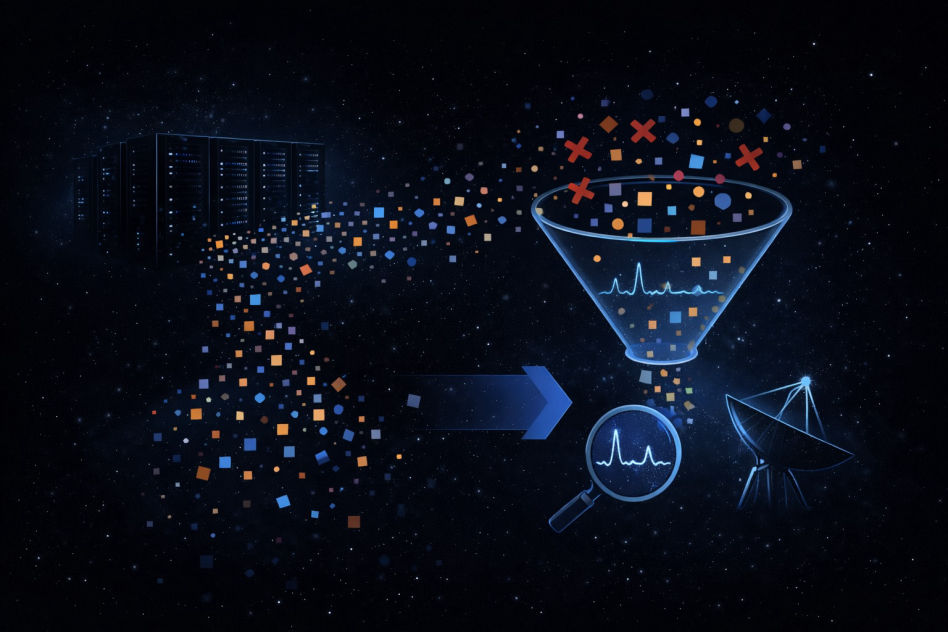
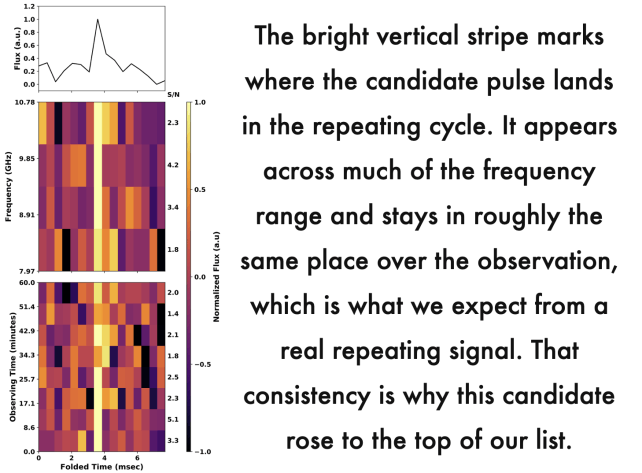
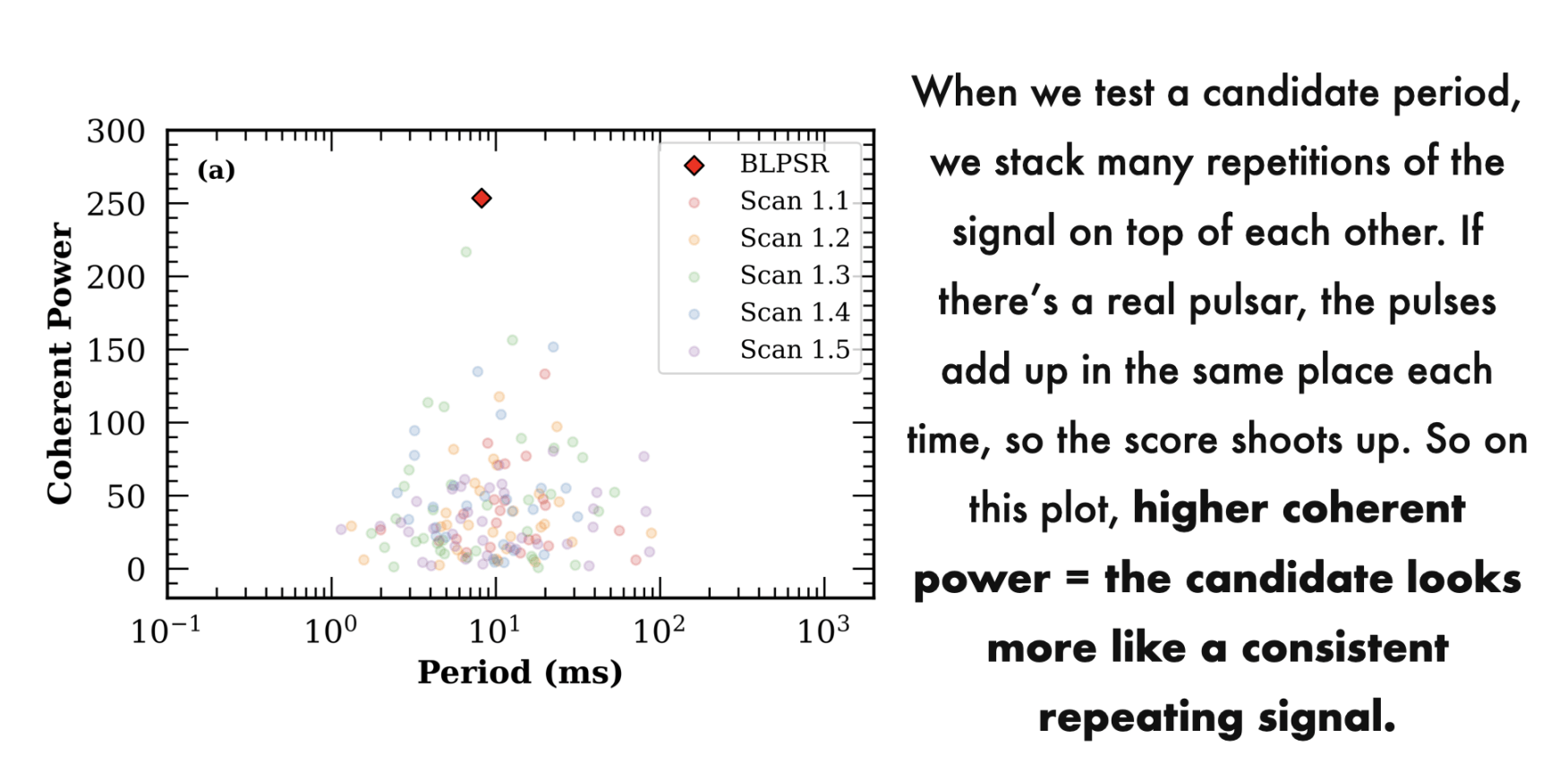
The supercomputer didn’t deliver one answer — it delivered a long list of “maybe” signals. Most were false alarms, so we sifted them down by removing duplicates and obvious look-alikes, then ranked what remained using how strongly each candidate matched a true repeating pulse pattern. BLPSR rose to the top of that list, standing out as one of the most pulsar-like candidates, which is why it became the focus of our deepest checks and follow-up searches.
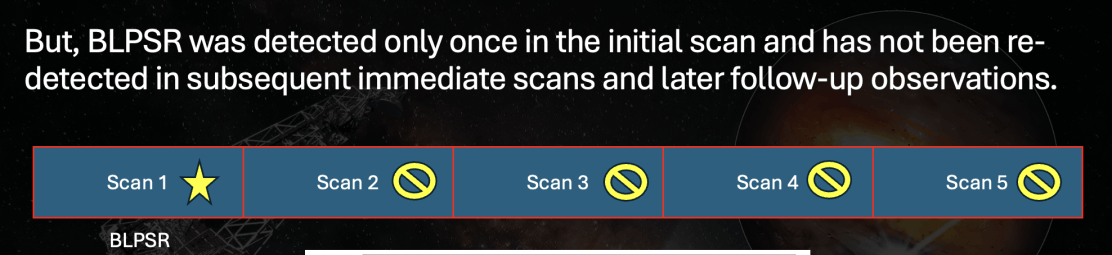
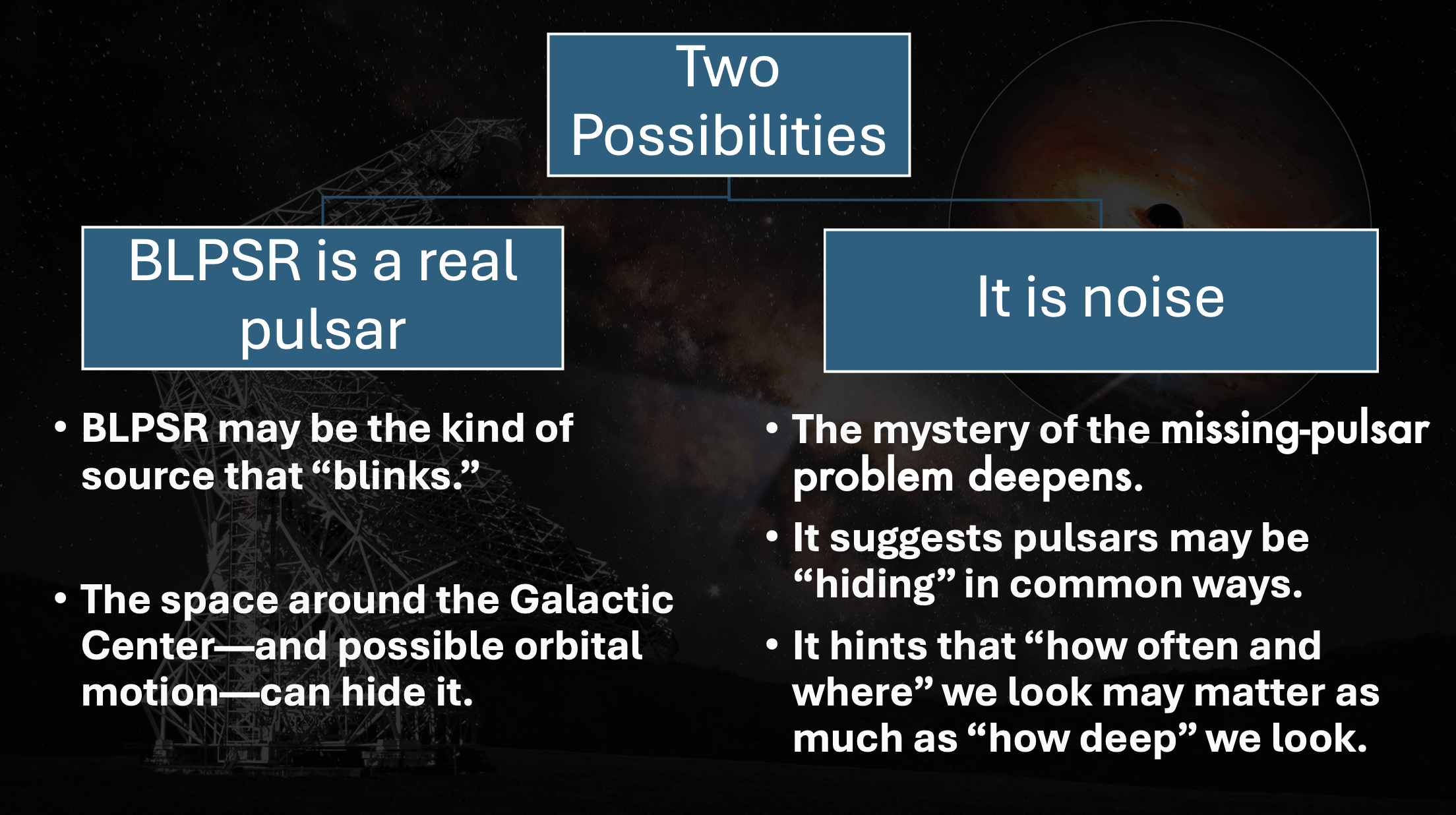
"Given the extraordinary implications of detecting a pulsar near SgrA*—we remain highly skeptical of BLPSR and emphasize that a much stronger burden of proof is required before asserting its astrophysical origin."
Perez et al. 2026, ApJ, 998, 147
Set up a website with Mobirise