Project MAGPIE

Modulation Agnostic Galactic Plane Investigation of Extraterrestrial Transmissions

The first deep survey of the ATA-visible Galactic midplane for modulation-rich alien transmissions — searching complex voltages, in real time, with entropy and cyclostationary statistics rather than narrowband power alone.

1. Why sixty years of narrowband searching is not enough

Radio technosignatures come in two broad flavors: deliberate beacons (designed to be found) and leakage (radar, interplanetary links, aggregate planetary transmitters — signals ETI would produce for themselves). Cocconi & Morrison (1959) made a strong case for ~Hz-scale continuous-wave (CW) carriers as efficient beacons. That idea shaped the field. Mid-century radios often had strong carriers, and a thin spectral line is easy to flag against noise.

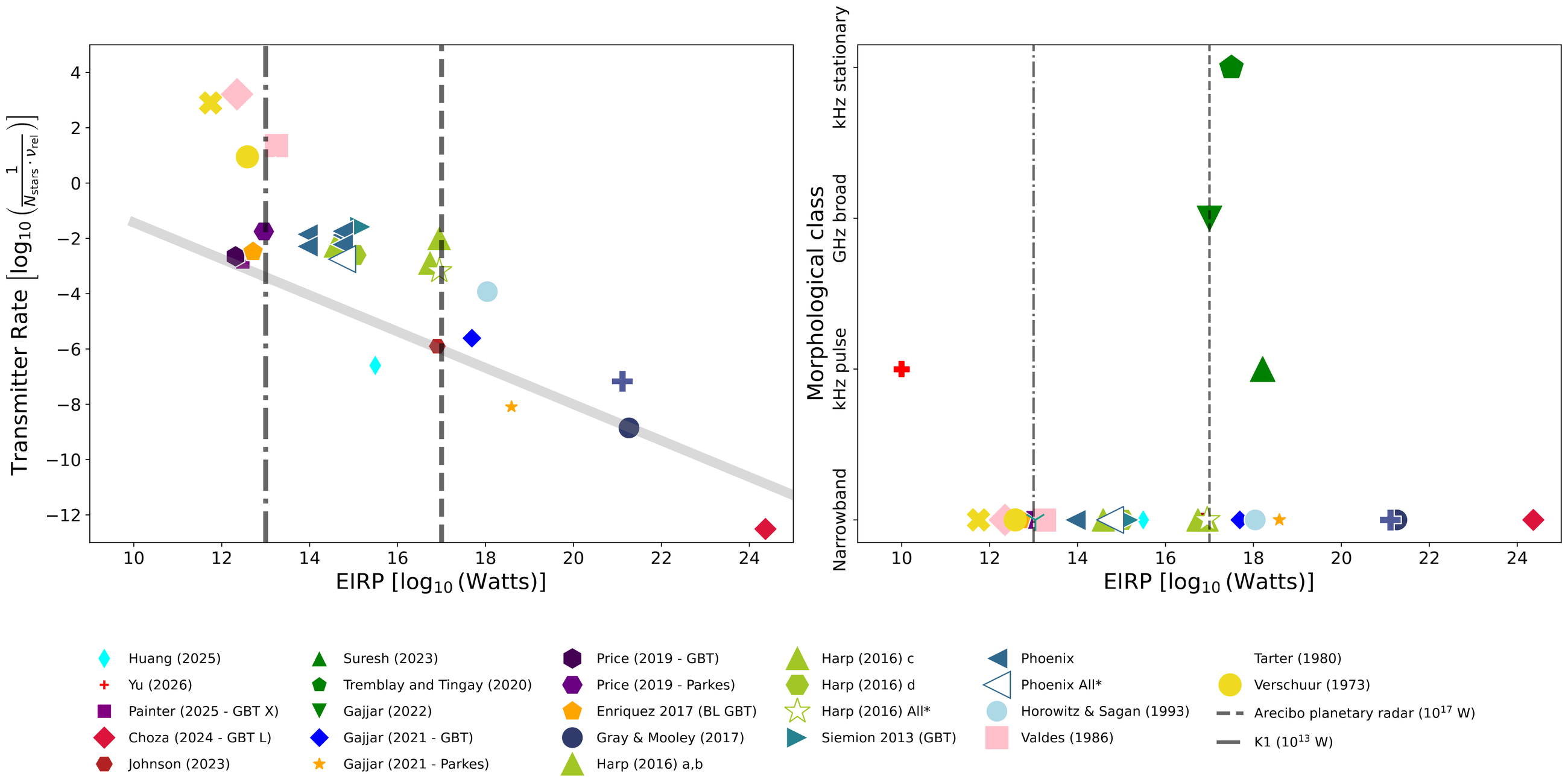
Modern engineered links look different. Information lives in modulation — sidebands, symbol clocks, pilots, cyclic prefixes, pulse trains — often spread across wider bandwidths rather than sitting in a persistent ~1 Hz tone. The figure below makes the resulting imbalance hard to unsee: sixty years of surveys have pushed impressively deep, but almost entirely along a single signal shape.

Two-panel comparison of radio technosignature surveys: transmitter rate versus EIRP sensitivity on the left, and morphological class versus EIRP on the right, showing that nearly every survey sits on the narrowband row

Figure — sixty years of radio SETI, plotted two ways. Both panels show the same set of published surveys, from Verschuur (1973) through to 2026. Left: the plane the field has traditionally used to measure progress. The horizontal axis is the weakest transmitter a survey could have detected (EIRP, in watts); the vertical axis is the transmitter rate — essentially the fraction of stars that would need to be transmitting for that survey to have seen one, so lower and further left is more constraining. The grey band traces the steady march of six decades of work, and the vertical lines mark two useful yardsticks: the Arecibo planetary radar (1017 W) and a Kardashev Type I power budget (1013 W). By this measure the field has done very well. Right: the same surveys re-plotted against the morphology of the signal they were actually sensitive to — and almost the entire compilation collapses onto one row, Narrowband. Only four entries sit anywhere else: Tremblay & Tingay (2020) for kHz-wide stationary signals, Gajjar (2022) for GHz-wide broadband pulses, and Suresh (2023) and Yu (2026) for kHz-wide pulses. Click the figure for a full-resolution version.

The two panels tell very different stories about the same body of work, and the contrast is the entire motivation for this project.

Read the left panel and radio SETI looks like a healthy, maturing field. Roughly two dozen published surveys spanning five decades march steadily down and to the left: each generation reached weaker transmitters and covered more stars than the last, and the modern Breakthrough Listen and ATA surveys sit orders of magnitude below where the field started. Sensitivity has never been the bottleneck.

Read the right panel and something is clearly missing. Every one of those surveys but four is stacked on a single row. The morphology axis — the axis describing what the signal actually looks like — is essentially unexplored, not because those regions were searched and found empty, but because the pipelines were never built to look there. The handful of exceptions are revealing in themselves: they are isolated efforts, each opening one narrow alternative (a kHz-wide pulse, a broadband burst) rather than a systematic sweep, and two of the four are the projects described in the next section.

This reframes what six decades of non-detections actually mean. They are a strong statement about deliberate narrowband beacons, and a much weaker one about everything else — the modulated carriers, radar chirps, spread-spectrum links, and bursty or noise-like emission that an unintentionally leaking civilization would most plausibly produce. The “great radio silence” may be less a property of the Galaxy than a property of our search space.

There is a second, sharper problem hiding inside even the narrowband column. Plasma in an exoplanetary system (the Exo-IPM) can spectrally broaden an intrinsically sharp carrier until standard CW pipelines miss it entirely — so some of those points may be less constraining than they appear, even on their own terms. Searching only for pristine tones in total-intensity spectra therefore under-samples both modern-looking leakage and genuine beacons that nature has already blurred.

2. Steps already taken away from CW-only

These earlier results opened the morphology door. The next step is the voltage domain.

Galactic Center SETI
Galactic Center deep survey

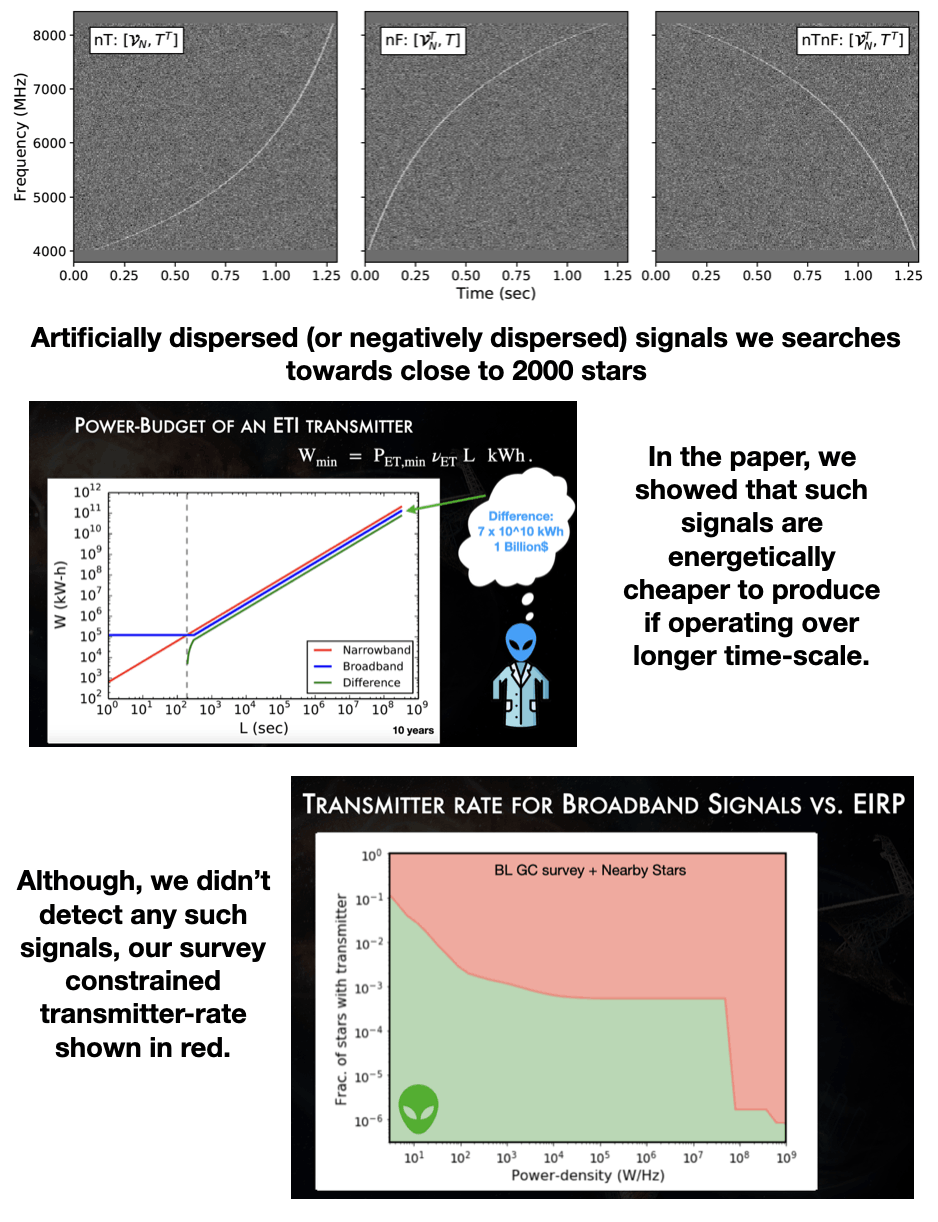
Gajjar et al. (2021) used the densest stellar field on the sky as a Schelling-point target and already stretched beyond a single CW morphology — placing limits on both drifting narrowband beacons and artificially dispersed transients across 1–100 GHz.

1883-star broadband pulsed search
~1883 nearby stars: broadband pulsed beacons (SPANDAK)

Gajjar et al. (2022) searched for artificially dispersed broadband pulsed beacons toward 1883 stars with SPANDAK and a CNN classifier — showing broadband pulsed morphologies can be energetically competitive with CW carriers.

Periodic spectral search context
BLIPSS: periodic pulsed signals (Suresh et al.)

Suresh et al. (2023) applied a fast folding algorithm (BLIPSS) to hunt channel-wide periodic pulse trains toward the Galactic Center — another human-familiar morphology that CW pipelines ignore.

3. The core idea: search in the voltage domain

Radio telescopes measure incident waves as a time series of complex voltages. On interferometers those voltages are usually channelized and then either (i) cross-correlated into visibilities for imaging, or (ii) coherently beamformed and detected into total intensity (dynamic spectra / filterbanks). Almost all radio SETI so far has lived on that last product — intensity after phase and fine-time structure have already been averaged away.

This project takes a different path: detect on the voltages themselves (raw or lightly channelized). Voltage-domain processing keeps full time resolution, complex phase, and polarization coherence. That is exactly where modulation lives. Because continuous voltage recording at modern rates is often impractical, the practical goal is a real-time detector that keeps up with the live stream — classical DSP and/or lightweight ML — rather than an offline archive dump.

3.1 Cyclostationary detection — “which frequencies talk to each other?”

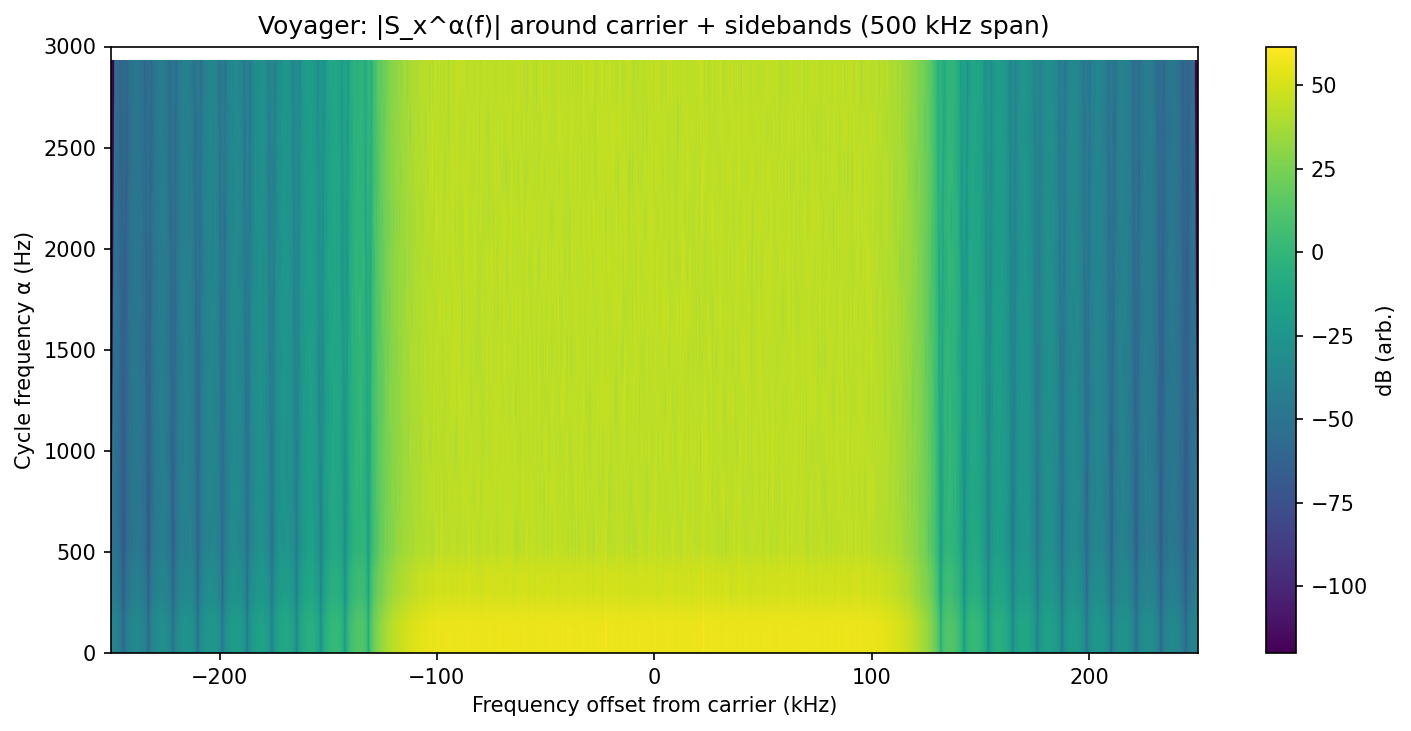
Stationary spectral analysis asks: what frequencies are present? Cyclostationary analysis asks: which frequencies talk to each other periodically? Most engineered transmissions imprint periodic structure in their second-order statistics — symbol clocks, framing, pilots, cyclic prefixes, pulse trains. If a signal carries information through repeated or synchronized processes, it leaves a fingerprint in the spectral correlation function Sxα(f), even when the total-intensity spectrogram looks empty.

In short: CW pipelines see power at a frequency; cyclostationary pipelines can recover modulation structure that never concentrates into a thin line.

Cyclostationary map vs total intensity and ATA localization

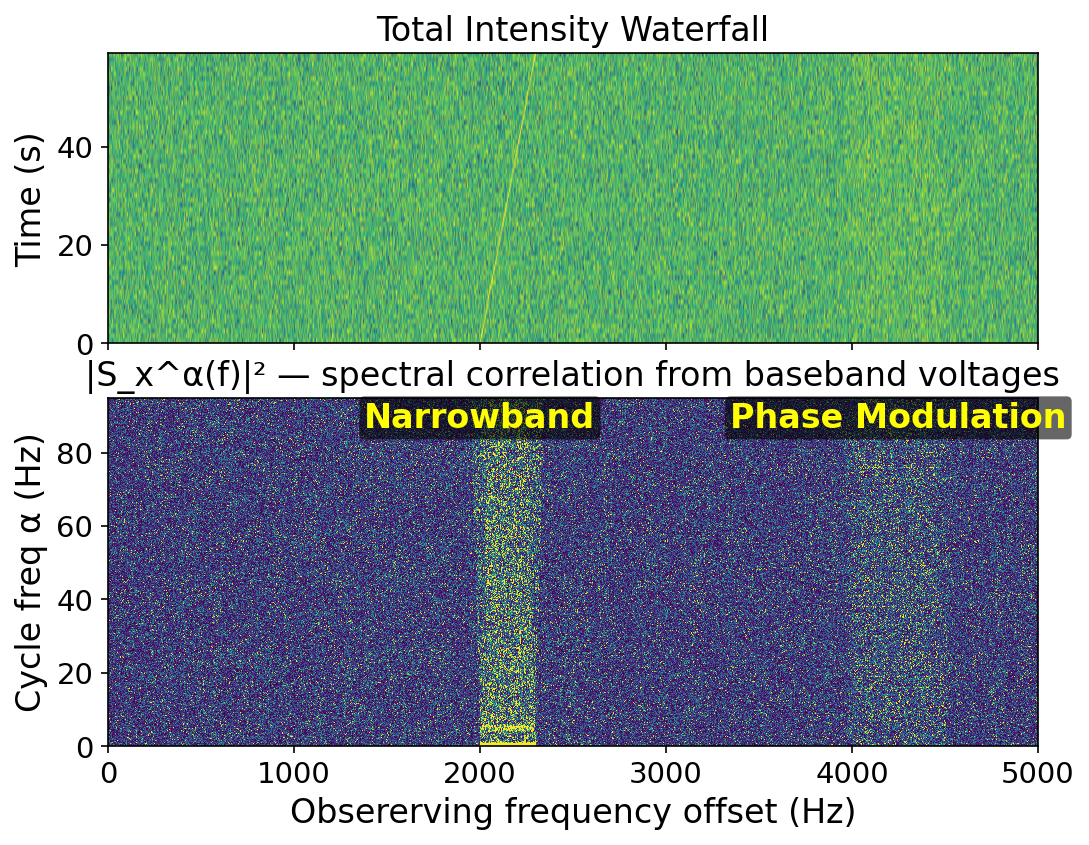
Figure — why cyclostationary methods matter (and how ATA helps reject RFI). Left: simulated 5 kHz baseband voltages with two injected signals — a weak drifting CW tone (~2000 Hz) and a phase-modulated waveform similar to planetary radar (~4000 Hz). Total intensity shows the CW tone but misses the modulated signal; the cyclostationary map in the (f, α) plane recovers both. Right: ATA interferometric imaging of a single pulsar pulse in ON vs OFF states — a point source appears on-sky only when the signal is present, showing how per-antenna voltages can localize a candidate time segment and help separate celestial signals from terrestrial interference.

3.2 Entropy-based detection — “how noise-like is this patch?”

Not every plausible technosignature is strongly cyclostationary. Some may be aperiodic, bursty, or deliberately noise-like. Entropy-based detection is the complementary, waveform-agnostic screen: under fixed binning, Gaussian noise is maximally random; structured emission (beacon or leakage) can push a time–frequency patch away from that maximum even when it never forms a narrow spectral line.

Entropy flags candidate regions; cyclostationary diagnostics and ATA sky localization then dig deeper. Together they cover morphologies that total-intensity CW searches never see.

Controlled injection into complex voltages: time-averaged spectrum, total intensity waterfall, and cyclostationary map

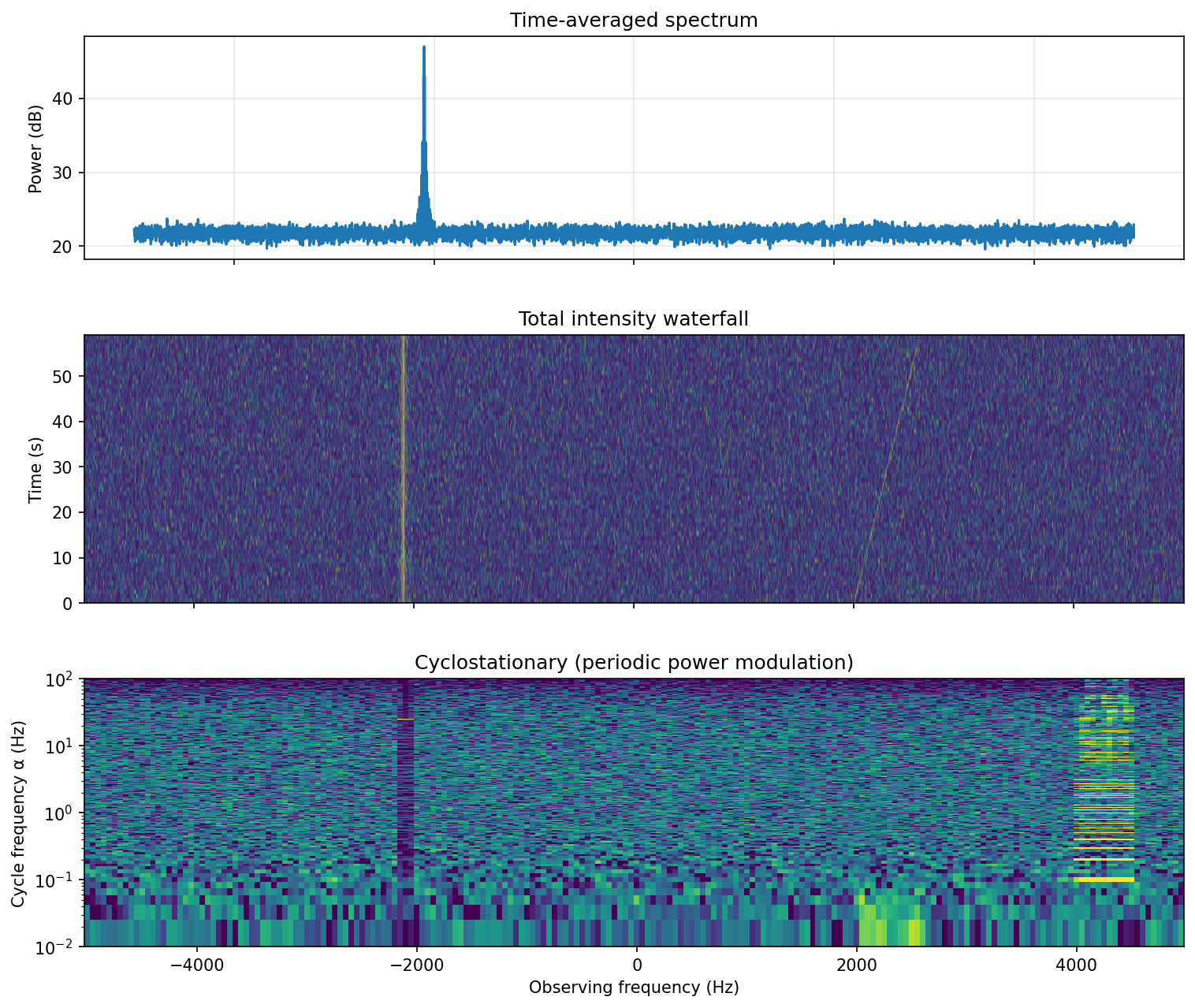
Figure — controlled injections into complex voltages. Modulated signals are injected into simulated baseband and pushed through the same three products a real search would produce. Top: the time-averaged spectrum shows only the narrowband carrier near −2000 Hz. Middle: the total-intensity waterfall — the product almost all previous radio SETI has used — adds a faint drifting tone but still shows nothing at +4200 Hz. Bottom: the cyclostationary map in the (f, α) plane lights up strongly at +4200 Hz, recovering a modulated transmission that is simply absent from both power-based views. Injections like these — drawn from labelled catalogues of familiar classes (FSK, PSK/QAM, OFDM, AM/FM, chirps, spread spectrum) via TorchSig, and spanning bandwidth, duty cycle, drift rate and signal-to-noise ratio — are how the detectors are calibrated and their completeness measured before and during the survey.

4. How we actually do this: ATA → Stelline → BLADE → CyberEther

The infrastructure is already funded, deployed and running. MAGPIE hangs new detectors on it.

Voltage-domain SETI only works if you can get telescope voltages onto a GPU fast enough to keep up with the sky. Continuous recording of raw voltages at these rates is not an option — the search has to happen live, and only the interesting slices get kept. That is exactly what the Stelline / BLADE / CyberEther stack at the Allen Telescope Array is built for, and it is already running.

The compute is already in place. Breakthrough Listen and the SETI Institute have funded a set of 4U servers with eight GPUs each, every one able to ingest up to 800 Gb s−1. Together they deliver 48 GPUs and roughly 4.8 Tb s−1 of aggregate ingest — enough to process 2.8 GHz of dual-polarization voltage data from all 42 ATA antennas with operational headroom. MAGPIE is not a request to build an instrument; it is a request to do new science on one that exists.
Stelline (stelline.space) is the radio-astronomy layer: ATA packet ingest, orchestration across the server farm, and writers for standard astronomy formats. Voltage packets move from the NIC straight into GPU memory (RDMA / GPUDirect-style paths), and finished products can leave GPU memory for NVMe via GPUDirect Storage — never touching host RAM on the critical path. It is already ingesting wideband voltage streams at the ATA today.
BLADE is the GPU beamformer. For MAGPIE it phase-aligns and coherently sums the antenna voltages into four adjacent complex-voltage beams per tuning, preserving timing, phase and polarization — deliberately stopping short of forming total intensity, because that is precisely the step that throws away the modulation.
CyberEther (cyberether.org) is the GPU-accelerated flowgraph environment where the detectors live: modular pipelines, heterogeneous acceleration, scheduling, buffering and real-time visualization. At the ATA it already ingests live data over 100 GbE, correlates, and displays baselines. Our entropy and cyclostationary detectors are packaged as CyberEther modules so they become part of an operational telescope graph rather than a one-off script.
From trigger to sky position. The four adjacent beams give coincidence rejection: a real celestial signal should not appear in all of them the same way that local interference does, which cuts the false-positive rate before anything reaches a human. A circular buffer then retains voltages only around surviving triggers — reduced diagnostic products routinely, limited-bandwidth cutouts for promising events, and full-band per-antenna voltages only for the highest-ranked candidates. Those per-antenna voltages feed the ATA's existing interferometric pathway, which images the candidate and either localizes it on the sky or exposes it as terrestrial.

In one sentence: Stelline gets raw ATA voltages onto the GPUs, BLADE turns them into coherent voltage beams, and CyberEther is where the entropy and cyclostationary search runs in real time — with the ATA's imaging path standing by to localize whatever survives.
5. On the sky: the Galactic plane survey

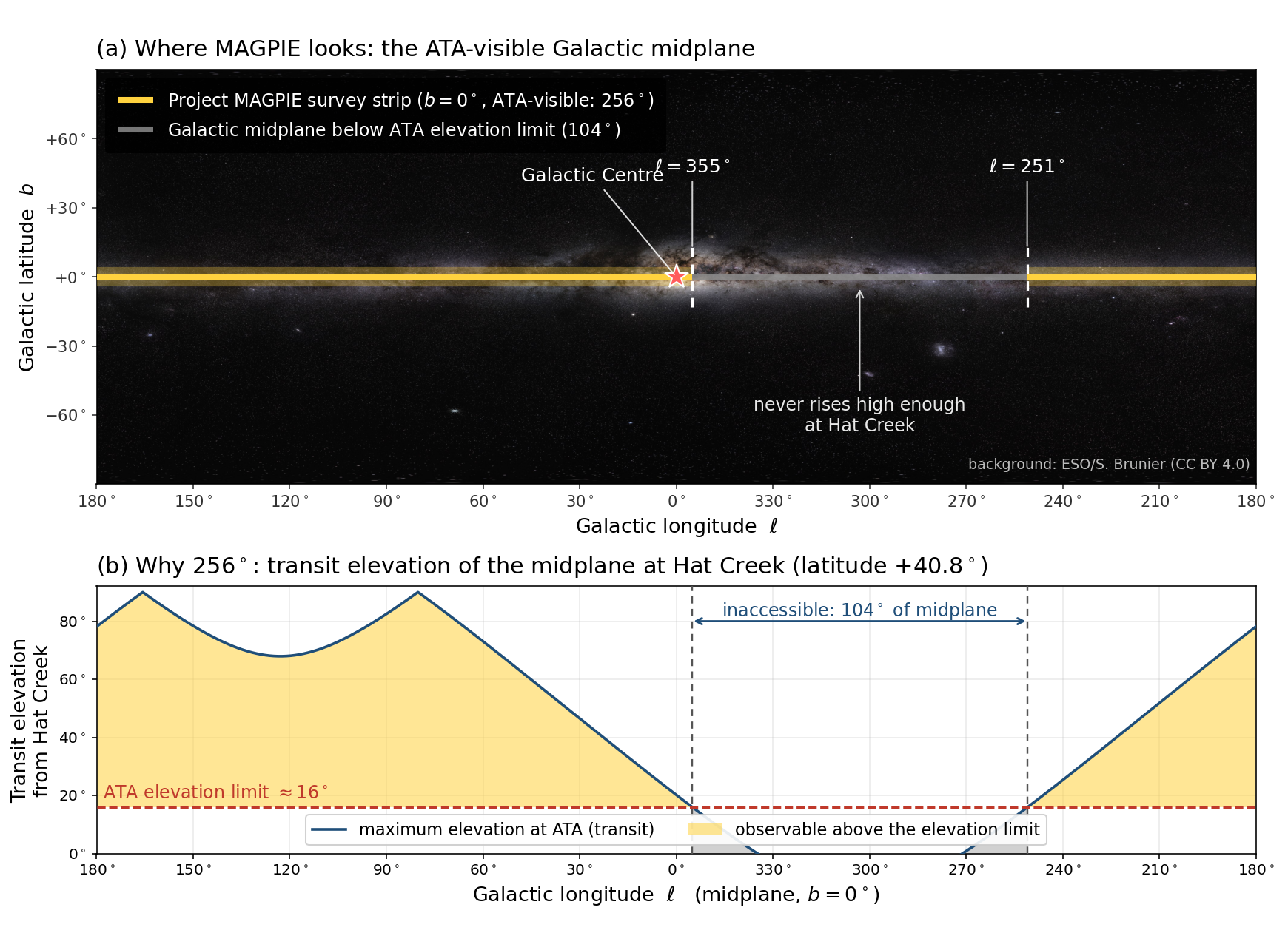
256° of ATA-visible Galactic midplane · ~7,700 pointings · 640 on-source hours · billions of stars

A new detection method deserves the richest possible hunting ground. Almost every radio technosignature search to date has been targeted: pick a list of nearby stars, point, observe. That is the right strategy when your sensitivity is set by distance — but it means the total number of stars ever examined remains modest, and the choice of targets encodes our assumptions about where life should be.

MAGPIE takes the opposite approach: a blind survey along the Galactic midplane, the single line on the sky where the stellar column density is highest. A pencil beam pointed at Galactic latitude b = 0° looks straight down the disk of our own Galaxy and integrates over an enormous number of stars at once. Trading distance for sheer numbers is the classic argument for plane surveys, and it is the natural first application of a modulation-agnostic detector: we are not asking “does this star transmit?” but “does the disk of the Galaxy contain engineered structure that power-based pipelines would have walked straight past?”

The Galactic plane is also the honest place to test the method. It is crowded with real astrophysical variability — pulsars, masers, transients — and it is where terrestrial interference has to be disentangled from genuine sky signals. If the pipeline can survive the plane, it can survive anywhere.

All-sky map in Galactic coordinates showing the 256 degrees of Galactic midplane visible from the Allen Telescope Array, and the transit elevation of the midplane from Hat Creek

Figure — the MAGPIE survey region. Top: an all-sky view in Galactic coordinates. The gold strip marks the stretch of Galactic midplane (b = 0°) that MAGPIE will survey — 256° of longitude, running from ℓ ≈ 355° eastward through the Galactic Centre and out to ℓ ≈ 251°. The grey stretch is the remaining 104°, containing the far-southern Carina–Crux–Centaurus arm; it lies too far south to be observed usefully from northern California. Bottom: why the number is 256°. The Allen Telescope Array sits at Hat Creek at latitude +40.8°, so each point on the midplane reaches a maximum (transit) elevation of 90° − |40.8° − δ|. Imposing a practical low-elevation limit of about 16° cuts the accessible midplane at exactly those two longitudes. The Galactic Centre itself (δ = −28.9°) transits at roughly 20° elevation — low, but reachable. Background image: ESO/S. Brunier (CC BY 4.0).

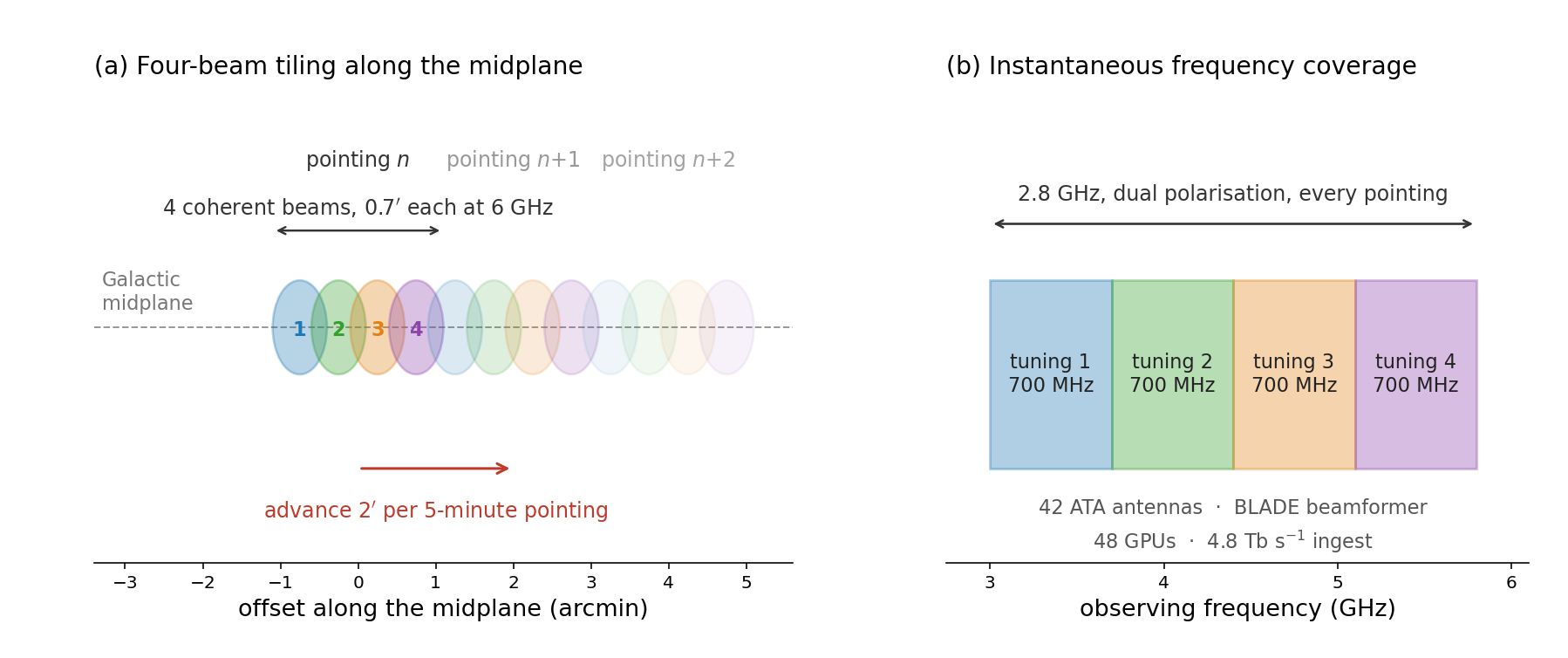
The survey mechanics follow directly from the beam size. BLADE forms four adjacent coherent voltage beams per tuning; at 6 GHz each is about 0.7 arcmin across. Advancing that four-beam pattern by 2 arcmin per pointing tiles the 256° strip in roughly 7,700 five-minute observations — about 640 on-source hours, necessarily spread over at least twelve months so that every Galactic longitude comes into favourable visibility. Four simultaneous 700 MHz tunings give 2.8 GHz of instantaneous bandwidth between 3 and 6 GHz, a relatively quiet part of the spectrum that still sits inside the terrestrial microwave window.

Injections distributed throughout the survey — not just at the start — quantify sensitivity as a function of signal strength, modulation type, bandwidth, duty cycle, drift rate and sky position. That is what converts a list of non-detections into an actual measurement.

Schematic of the four-beam tiling along the Galactic midplane and the four simultaneous 700 MHz tunings between 3 and 6 GHz

Figure — survey strategy. Left: four adjacent coherent beams (each ~0.7 arcmin at 6 GHz) are formed simultaneously from the ATA voltages. They serve two purposes at once — they tile the midplane as the pattern advances 2 arcmin per five-minute pointing, and they provide coincidence rejection, since a candidate that appears identically in all four beams is far more likely to be local interference than a celestial source. Right: four simultaneous 700 MHz tunings deliver 2.8 GHz of dual-polarization complex voltages per pointing within the 3–6 GHz band, drawn from 42 antennas and processed by 48 GPUs.

6. Where this work is headed

This is an active research effort at the SETI Institute and the Allen Telescope Array, developed with collaborators on Stelline, BLADE and CyberEther, and with support from Breakthrough Listen and the SETI Institute for the hardware and computing already deployed.

Near-term deliverables. (1) A validated, reusable voltage-domain search pipeline — entropy and cyclostationary detectors packaged as CyberEther modules on the live Stelline stream, benchmarked against labelled injections and commissioned against real engineered modulations such as Mars-orbiter downlinks, with an open code and data release. (2) The first deep survey of the ATA-visible Galactic midplane for modulation-rich transmissions, published with a full completeness analysis and the resulting population-level constraints.

Both outcomes matter, including the quiet one. A detection would rank among the most consequential discoveries in history; a non-detection would still give the first quantitative limits on how common modulation-rich transmissions are along the Galactic plane — a region of technosignature parameter space that sixty years of narrowband searching has left essentially unmeasured.

The scientific goal is simple and ambitious: stop asking only “is there a thin line?” and start asking “is there engineered structure in the voltages?”


If alien technology looks anything like ours, the interesting information lives in the modulation — not only in the carrier.


Set up a website with Mobirise