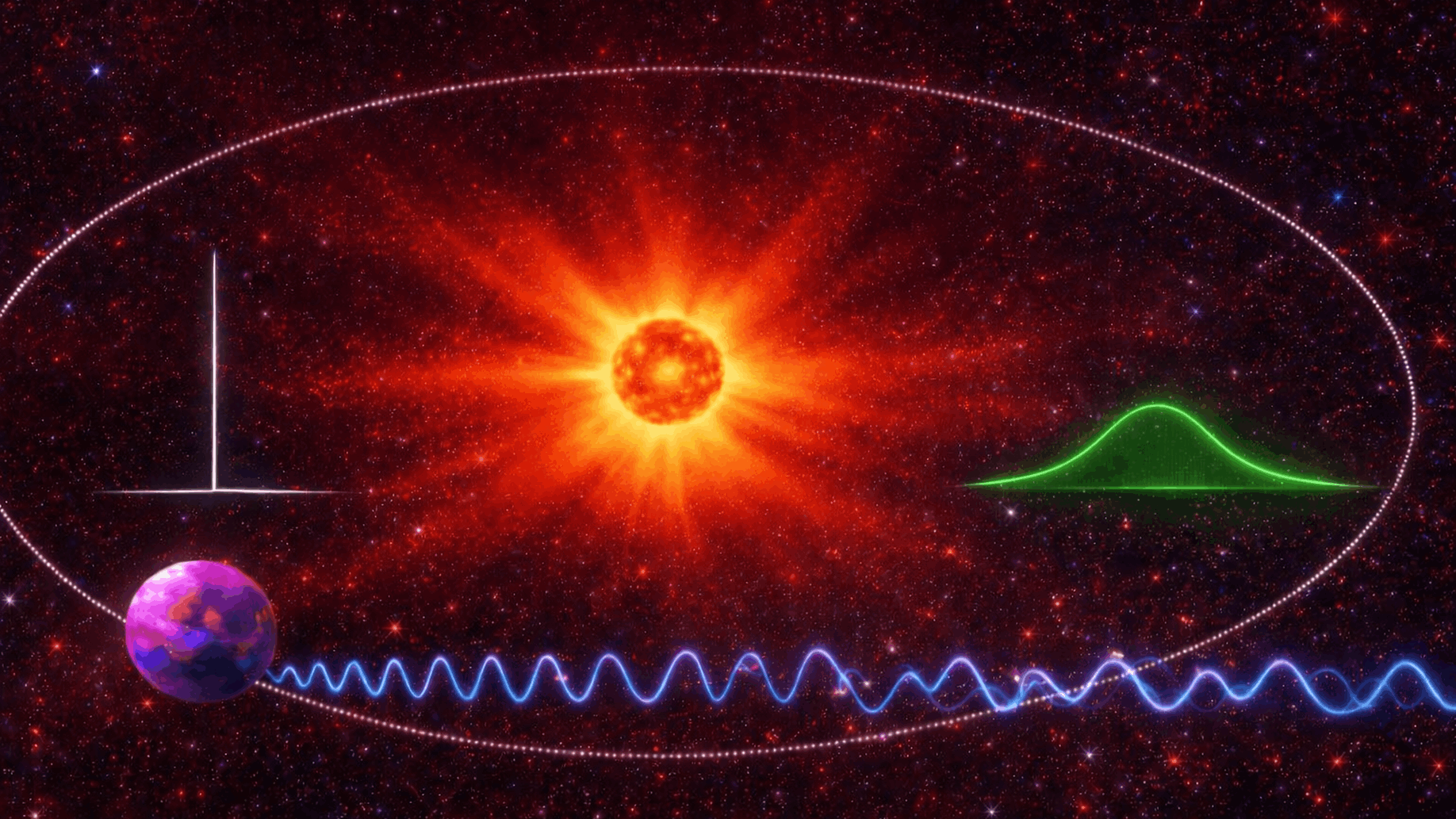
Radio SETI searches usually look for extremely thin, “needle-like” signals in frequency. Our paper shows that a signal like that can get smeared out by the plasma around its own star (the star’s wind and occasional outbursts). When the signal passes close to the star along our line of sight, turbulence spreads its power across a wider range of frequencies, so the peak becomes weaker and harder for standard narrowband searches to detect.
We built a model that predicts how much smearing happens based on observing frequency, how close the signal passes to the star, and how turbulent the star’s environment is. We tested the model using many real measurements of this effect in our own solar system, then scale it to other stars, especially M-dwarfs. In simulations of a 1 GHz survey of one million nearby stars, most systems produce more than 1 Hz of broadening, and a large fraction produce more than 10 Hz—especially around M-dwarfs. At lower radio frequencies the effect is much stronger. Coronal mass ejections are rare during a typical observation, but if one happens, it can broaden the signal by thousands of Hz.
Overall, our paper argues that “star-caused smearing” can hide narrowband technosignatures and may be one reason for the "Great Silence".
Designed with Mobirise - Click now